What Is the Average IQ Of World and How Is It Measured?
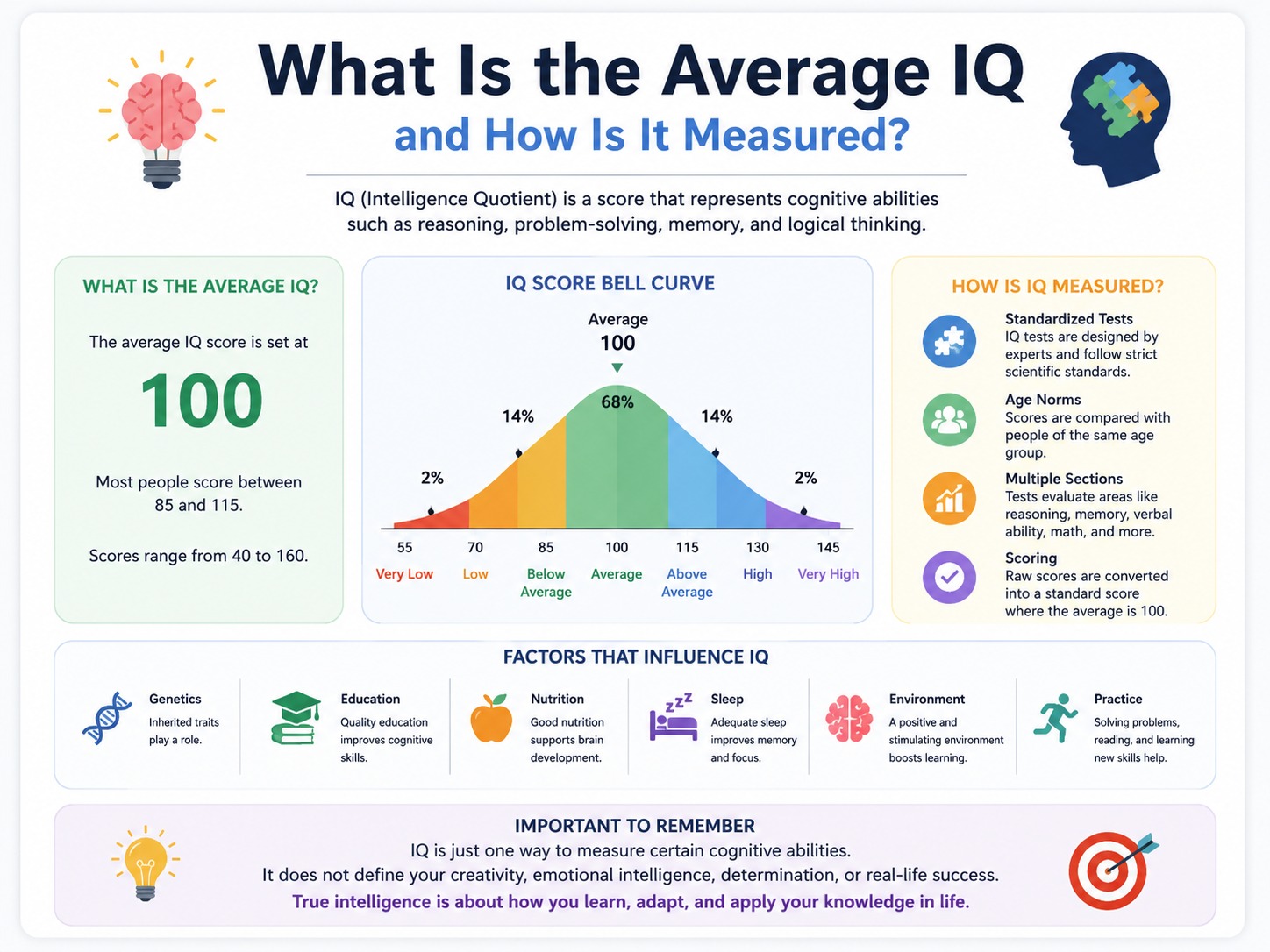
Human intelligence has fascinated scientists and psychologists for over a century. One of the most common ways to estimate intelligence is through an IQ test. IQ stands for “Intelligence Quotient,” and it measures cognitive abilities such as reasoning, memory, problem-solving, and logical thinking. Although IQ is often linked with genius-level intelligence, many people still do not fully understand what it actually means or how it is measured. The average IQ score is set at 100. This does not mean everyone scores exactly 100, but rather that IQ tests are designed so most people fall near this number. Generally, scores between 85 and 115 are considered the average range. Scores above 130 are often classified as very high intelligence, while scores below 70 may indicate cognitive difficulties. The idea of IQ testing began in the early 1900s when French psychologist Alfred Binet developed a method to identify students who needed additional educational support. His work later became the foundation for modern intelligence testing. Today, some of the most recognized IQ tests include the Stanford-Binet Intelligence Scale, Wechsler Adult Intelligence Scale (WAIS), and Raven’s Progressive Matrices. Modern IQ tests are carefully standardized. Researchers test thousands of people from different age groups and backgrounds to create a statistical average. Scores are then adjusted so the population average remains at 100. This allows psychologists to compare an individual’s performance with the general population. IQ scores follow what scientists call a “bell curve” or normal distribution. Most people score around the average range, while very high and very low scores are much rarer. Only a small percentage of people score above 140, which is often described as genius-level intelligence. However, IQ is far more complex than many people think. A high IQ does not guarantee success, wealth, or happiness. Likewise, many individuals with average IQ scores become highly successful because of creativity, discipline, emotional intelligence, and hard work. This is why experts believe intelligence cannot be fully measured by a single number. Researchers have found that both genetics and environment influence IQ. While inherited traits may provide a foundation, factors such as nutrition, education, healthcare, sleep, and childhood experiences also play major roles in cognitive development. Children raised in supportive learning environments often perform better on intelligence-related tasks. Education is one of the strongest influences on IQ performance. Reading regularly, solving puzzles, learning new skills, and practicing analytical thinking can improve cognitive abilities over time. Scientists also discovered the “Flynn Effect,” which refers to the steady rise in average IQ scores across generations. Researchers believe this increase happened because modern life requires more abstract thinking and problem-solving than previous generations experienced. Despite its popularity, IQ testing has received criticism. Some psychologists argue that cultural background, language, and educational opportunities can affect test results. Because of this, IQ tests should not be seen as a perfect measure of human potential. Modern psychology recognizes multiple forms of intelligence beyond traditional IQ. Emotional intelligence, creativity, leadership, communication skills, and practical problem-solving are also important in real life. Some people may not score exceptionally high on IQ tests but still excel in business, art, or leadership. Technology and neuroscience are also changing how researchers understand intelligence. Brain studies suggest intelligence comes from complex neural connections rather than a single “smartness center” in the brain. Scientists now believe the brain remains adaptable throughout life, meaning intelligence can continue developing through learning and experience. Ultimately, IQ is best viewed as a tool for measuring certain cognitive abilities rather than a complete definition of intelligence. It can provide useful insights into reasoning and analytical skills, but it cannot measure ambition, wisdom, creativity, or determination. True intelligence is much broader than a single score, and success in life depends on how effectively a person uses their abilities.