The Four Color Problem: The Simple Puzzle That Took 124 Years to Solve
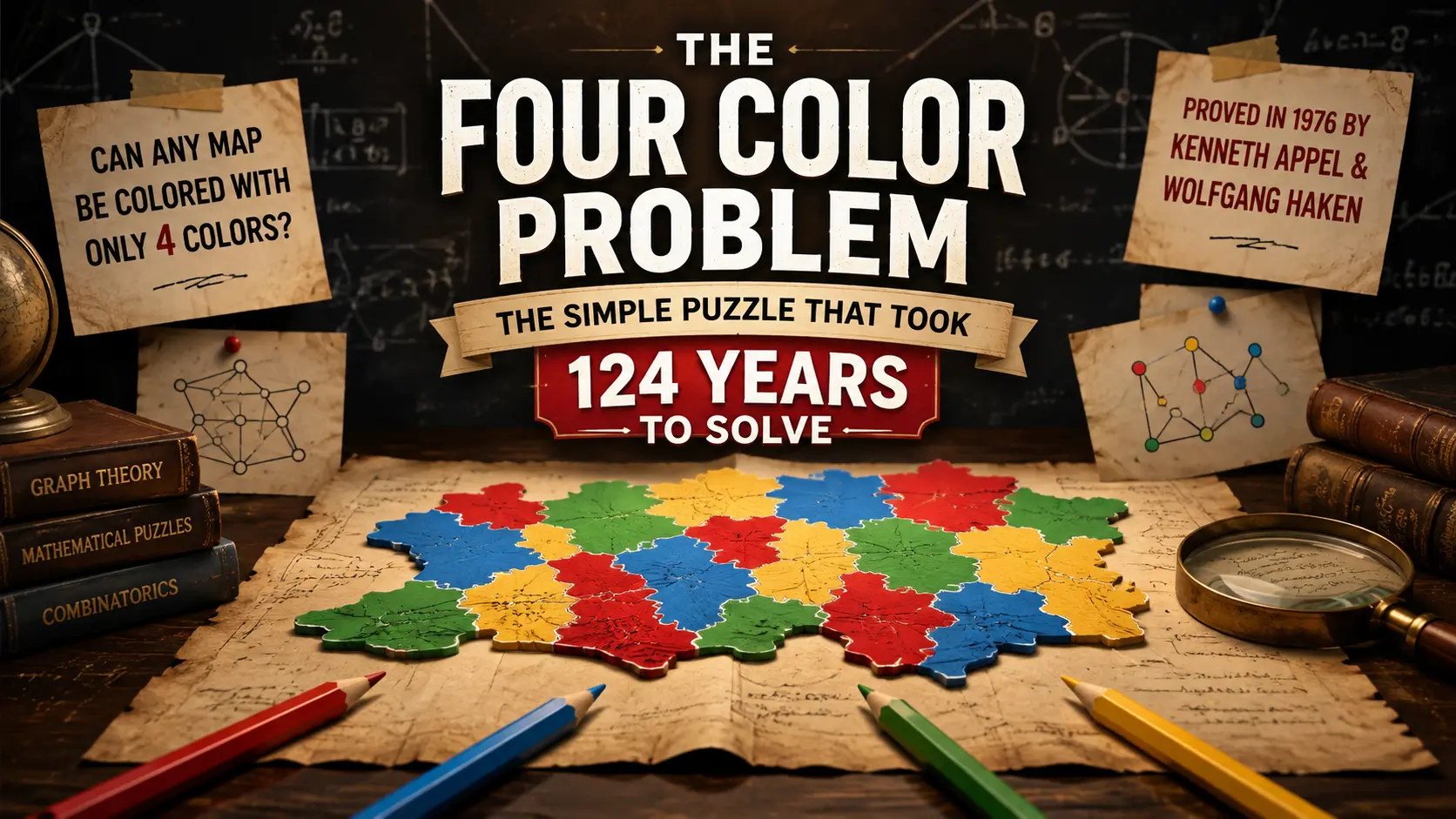
Imagine someone gives you a map and four colors—red, blue, green, and yellow. Your task seems ridiculously simple: color every region of the map so that two neighboring regions never have the same color. You might think this is something a child could solve with a few crayons. But now comes the extraordinary question: Can every possible map in the world be colored using only four colors? That innocent-looking question became one of the most famous problems in the history of mathematics. Known as the Four Color Problem, it confused and challenged mathematicians for more than a century. It wasn't finally proved until 1976, when mathematicians Kenneth Appel and Wolfgang Haken used computers as an essential part of their proof. But the story of the Four Color Problem isn't simply about coloring maps. It is a story about human intelligence, mathematical creativity, persistence, computers, and a question that looks incredibly easy until you try to prove it. 🧩 What Exactly Is the Four Color Problem? The Four Color Problem, also called the Four Color Map Problem, asks a surprisingly simple question: Is it always possible to color any map using no more than four colors so that neighboring regions have different colors? There is one important rule. Two regions are considered neighboring only when they share a boundary of some length. If two regions touch only at a single corner, they don't count as neighbors. For example, imagine a map divided into several countries. If Country A shares a border with Country B, they cannot both be red. Country A might be red, Country B blue, and another neighboring country green. As the map becomes more complicated, you might need more colors—or at least, that's what mathematicians initially wondered. The remarkable claim of the Four Color Problem is that four colors are always enough, regardless of how complicated the map becomes. Think about how enormous that statement is. It doesn't ask whether you can color one particular map. It asks whether the rule works for every possible map that could be constructed. And proving something about every possible map is where this simple puzzle becomes incredibly difficult. 🎨 It Started With a Map of England The story of the Four Color Problem began in 1852 with a student named Francis Guthrie. Guthrie was coloring a map of the counties of England when he noticed something interesting. He discovered that he could color the map using four colors without giving the same color to neighboring regions. This led to a question that would eventually become famous: Could every map be colored with only four colors? Guthrie discussed the problem with his brother Frederick, who was studying mathematics. Frederick later mentioned the problem to the mathematician Augustus De Morgan, one of the most important mathematicians of the nineteenth century. The problem gradually spread through the mathematical community. At first, it seemed like it should have a simple proof. After all, the question itself could be explained in a few sentences. But mathematicians quickly discovered something frustrating. They could successfully color thousands of individual maps with four colors. What they couldn't prove was that no possible map would ever require a fifth color. That distinction turned the Four Color Problem from a fun puzzle into a serious mathematical challenge. 🤯 Why Was Such a Simple Puzzle So Difficult? This is the part that makes the Four Color Problem so fascinating. Suppose I give you a map with ten regions. You can probably find a four-coloring fairly quickly. Now imagine a map with hundreds or thousands of regions. You could still potentially color it with four colors. But mathematics doesn't allow you to say: “I tried lots of maps, and four colors always worked.” That isn't a proof. To solve the Four Color Problem, mathematicians needed to demonstrate that there could never exist even one map that required five colors. And there are essentially unlimited ways to create complicated maps. You can add regions, create narrow borders, surround one region with many others, connect distant-looking regions, and create increasingly complicated structures. The number of possible configurations becomes enormous. This is why the Four Color Problem became one of the most famous hardest math problems of its era. The difficulty wasn't in understanding the puzzle. The difficulty was proving the answer for every possible case. 🔢 From Maps to Mathematics Eventually, mathematicians discovered that the Four Color Problem could be transformed into a problem involving mathematical structures called graphs. Instead of thinking about countries on a map, imagine representing every region as a point, or vertex. Whenever two regions share a boundary, connect their points with a line. Now the map becomes a mathematical graph. The problem changes from: “Can we color this map with four colors?” to: “Can every planar graph be colored using four colors so that connected vertices have different colors?” This transformation was incredibly important because it allowed mathematicians to study the problem using graph theory, a field of mathematics that examines connections and relationships between objects. Suddenly, the colorful map on a piece of paper became an abstract mathematical structure. And the puzzle became much deeper. ⏳ More Than a Century of Failed Attempts For decades, mathematicians tried to prove the Four Color Problem. Some researchers believed they had found proofs, only for errors to be discovered later. Others proved weaker versions of the problem. For example, mathematicians eventually established that maps could be colored using five colors. But the real challenge was proving that four colors were always sufficient. This created a strange situation. Mathematicians were increasingly confident that the Four Color Conjecture was true. They could test complicated maps. They could construct clever arguments. They could prove important related results. But the final proof remained out of reach. For more than 100 years, the Four Color Problem remained one of mathematics' most famous unsolved questions. Then came a development that would completely change the story. 💻 The Computer Enters the Four Color Problem In the 1970s, mathematicians Kenneth Appel and Wolfgang Haken began working on a radically different approach. Instead of trying to examine every possible map directly, they developed a method for reducing the problem to a finite collection of configurations that needed to be checked. The crucial question became: Could all of those configurations be systematically examined? The answer was yes—but there were far too many cases for humans to practically check one by one. So Appel and Haken turned to computers. In 1976, they announced that they had proved the Four Color Theorem. Their work showed that any possible counterexample would have to contain one of a particular set of configurations, and their computer calculations demonstrated that these configurations could not produce a genuine counterexample. After more than a century, the Four Color Problem finally had a proof. But solving the problem created another fascinating problem. 🤖 Can a Computer-Checked Proof Really Be a Mathematical Proof? This is one of the most interesting parts of the entire story. Traditional mathematical proofs are normally designed so that another mathematician can examine the reasoning step by step. You read the assumptions. You follow the logical arguments. You verify the calculations. Then you reach the conclusion. The Four Color Theorem introduced something different. A significant part of the verification relied on computer calculations. The computer could check an enormous number of configurations much faster than a human possibly could. But that raised a philosophical question: If humans cannot realistically check every individual computer calculation by hand, should the result still be considered a mathematical proof? Some mathematicians were initially uncomfortable with this idea. The issue wasn't that computers were unreliable in principle. The issue was that mathematical proof had traditionally been something humans could inspect and understand directly. The Four Color Theorem helped push mathematics into a new era where computational mathematics became increasingly important. Today, computer-assisted proofs are much more accepted, although mathematicians continue to care deeply about verification, reliability, algorithms, and independently checking computational results. 🧠 What Does the Four Color Problem Tell Us About Intelligence? The Four Color Problem is more than an interesting chapter in mathematics history. It reveals something important about human intelligence. The problem wasn't solved simply by having a high IQ or performing calculations faster. It required mathematicians to look at the problem differently. Instead of endlessly coloring maps, they transformed the problem into graph theory. Instead of examining every imaginable map, they searched for ways to reduce the infinite-looking problem to a manageable collection of cases. This is a fundamental characteristic of advanced problem-solving: Intelligence isn't always about calculating faster. Sometimes it's about discovering a better way to think about the problem. That idea is at the heart of what puzzles are designed to test. A difficult puzzle can challenge your logical reasoning, pattern recognition, spatial thinking, working memory, and ability to recognize hidden relationships. The Four Color Problem demonstrates something even deeper: sometimes the breakthrough doesn't come from working harder on the original problem. It comes from changing the way you represent the problem. 🔥 Could You Have Solved the Four Color Problem? Here's a thought experiment. Imagine you are a mathematician in the nineteenth century. Nobody has told you the answer. You have no modern computers. You don't know whether four colors are enough. You take a complicated map and successfully color it with four colors. Then you try another. And another. And another. Eventually, you might become convinced that four colors are always enough. But then comes the terrifying question: What about the map you haven't thought of yet? That is the difference between finding an answer and proving an answer. You might be excellent at puzzles and still struggle with this problem because the challenge isn't simply to discover a working solution. The challenge is to establish that no counterexample exists anywhere in the enormous universe of possible maps. That is what made the Four Color Problem so extraordinary. 🌍 Why Does the Four Color Theorem Matter Today? The Four Color Theorem became an important milestone in graph theory, algorithms, computational mathematics, and mathematical proof. The underlying ideas behind map coloring appear in many areas where resources need to be assigned without conflicts. Coloring can represent assigning frequencies, scheduling tasks, organizing networks, allocating resources, and solving constraint-based problems. The mathematics also provides an excellent example of how a seemingly simple question can lead to sophisticated ideas. And perhaps its biggest contribution is philosophical. The Four Color Problem demonstrated that mathematics was entering an age where humans and computers could work together to solve problems that would be extremely difficult for either one to handle in the same way alone. That idea feels even more relevant today, in an era of artificial intelligence and powerful computational systems. 🧩 The Real Lesson Behind the Four Color Problem The Four Color Problem began with something almost everyone understands: coloring a map. There were no complicated equations in the original question. No advanced physics. No mysterious scientific equipment. Just four colors. Yet that simple question occupied mathematicians for 124 years. And that's what makes the Four Color Problem so fascinating. The hardest problems don't always look difficult. Sometimes the most challenging questions are the ones that are easy enough for anyone to understand but difficult enough that even the world's greatest minds struggle to prove the answer. The Four Color Theorem is therefore more than a theorem about maps. It is a story about curiosity, persistence, creativity, mathematical reasoning, and the changing relationship between humans and computers. It reminds us that intelligence isn't simply knowing the answer. Intelligence is having the ability to discover the path toward an answer when nobody has shown you the way. And perhaps that's the real reason puzzles have fascinated humans for thousands of years. A puzzle asks a simple question. Your brain turns it into an adventure.