Signs of Extremely Low IQ in People: What Research Reveals
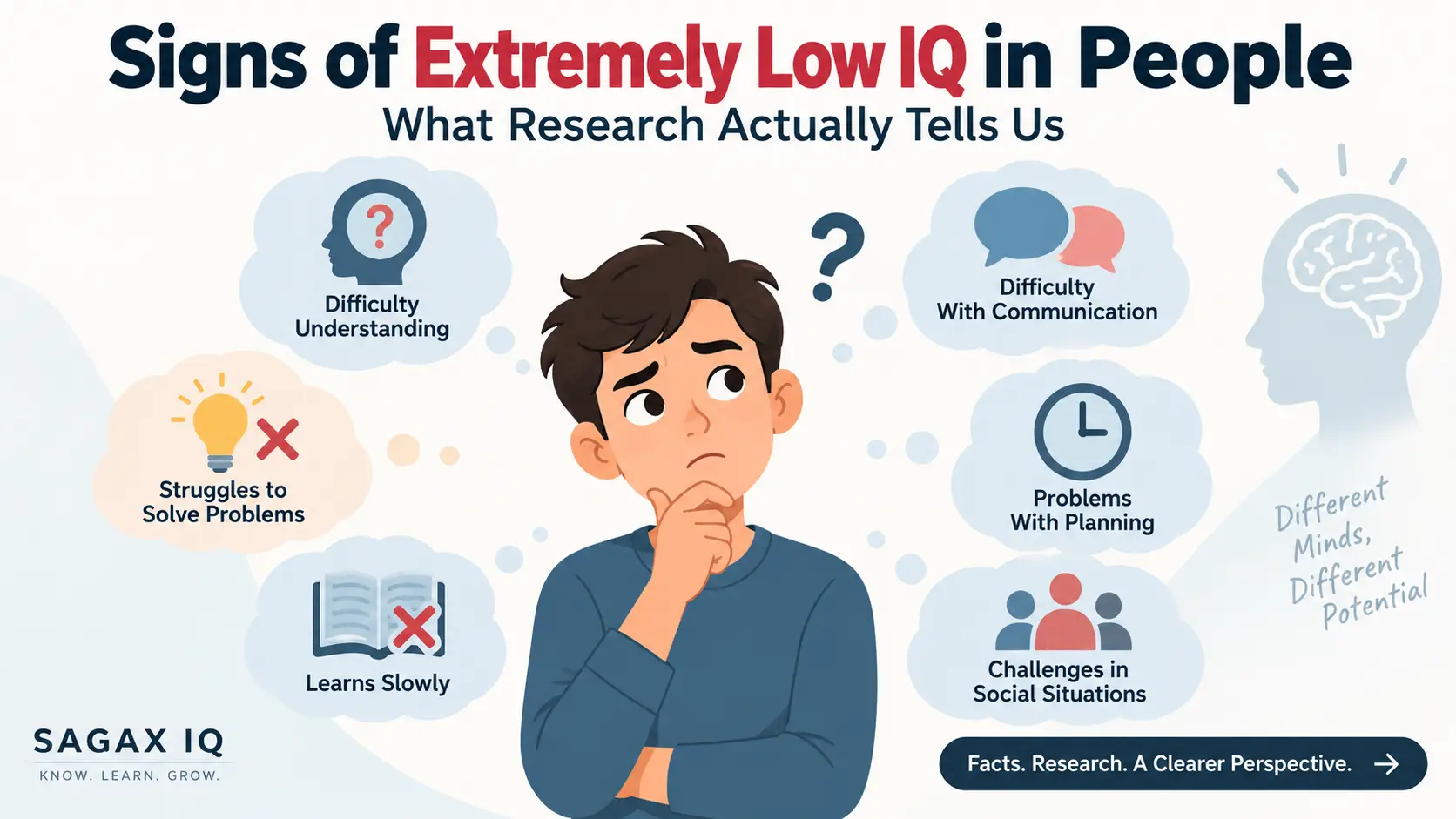
When people hear the phrase “extremely low IQ,” they often imagine someone who struggles to understand simple questions, make everyday decisions, or learn new skills. But psychology research paints a much more complicated picture. A person cannot reliably be identified as having a very low IQ simply because they speak slowly, make poor decisions, perform badly in school, or behave differently from others. Intelligence is multidimensional, and everyday functioning is influenced by education, language, culture, socioeconomic circumstances, mental health, neurological conditions, and many other factors. More importantly, a very low IQ score is not, by itself, enough to diagnose intellectual disability. Modern diagnostic frameworks consider both intellectual functioning and adaptive functioning—how effectively a person manages conceptual, social, and practical demands of everyday life. This distinction is essential when discussing the signs associated with extremely low intellectual functioning. What Does “Extremely Low IQ” Actually Mean? IQ tests are designed so that the population average is approximately 100, with a standard deviation of about 15 on commonly used tests. A score around 70 is approximately two standard deviations below the mean. Statistically, that is a very low score, but it should not be interpreted as a complete description of a person's intelligence or capabilities. The American Association on Intellectual and Developmental Disabilities (AAIDD) explains that significant limitations in intellectual functioning are generally indicated by an IQ around 70–75 or below, taking measurement error and the appropriateness of the test into account. However, diagnosis also requires significant limitations in adaptive behavior and onset during the developmental period. Modern clinical practice therefore asks a broader question: How does the person's cognitive ability affect their ability to understand, learn, communicate, solve problems and function independently in real life? This is why two people with similar IQ scores can have very different lives and support needs. 1. Difficulty Understanding Complex Instructions One of the clearest patterns associated with significant intellectual limitations is difficulty processing multi-step or abstract instructions. For example, consider these two instructions: Simple: “Put the glass on the table.” Complex: “Put the glasses in the kitchen, check whether the dishwasher is full, and if it is, leave the dirty dishes beside the sink.” The second instruction requires the person to: remember several pieces of information, understand sequence, make a decision, shift attention, and complete multiple actions. Someone with significant intellectual limitations may repeatedly ask for clarification, complete only part of the instruction, or become confused when the task changes. This doesn't necessarily mean they cannot learn. In fact, people with intellectual disabilities can acquire many practical skills when information is presented clearly and with appropriate support. AAIDD emphasizes that people may have limitations alongside important strengths and that appropriate supports can improve functioning. 2. Struggling to Solve New Problems Another important characteristic is difficulty solving unfamiliar problems. Imagine someone normally uses a remote control to operate a television. Suddenly, the batteries stop working. A person with stronger problem-solving skills might reason: The remote isn't working. The television itself appears functional. The batteries may be dead. I'll replace or test the batteries. Someone with significant cognitive limitations may repeatedly press the same buttons without considering alternative explanations. The important issue isn't whether someone makes mistakes. Everyone makes mistakes. The stronger warning sign is a persistent inability to modify a strategy when the original strategy clearly isn't working. Problem solving, reasoning, planning, abstract thinking, judgment and learning from experience are among the cognitive abilities considered when evaluating intellectual functioning. 3. Difficulty Learning From Experience One particularly important distinction between ordinary mistakes and significant cognitive limitations is learning from previous outcomes. Suppose someone repeatedly makes the same mistake: They touch a hot surface. They get burned. They are warned about it. Later, they repeat exactly the same behavior without understanding why it is dangerous. A single incident means almost nothing. But when a person consistently fails to extract lessons from previous experiences, especially across different situations, it can indicate limitations in reasoning and adaptive functioning. Research-based definitions of intellectual functioning specifically include the ability to learn from experience. 4. Difficulty Understanding Consequences People with substantial intellectual limitations may have trouble connecting an action with a future consequence. For example: “If I spend all my money today, I won't have enough for food tomorrow.” Understanding this requires future-oriented reasoning. Similar difficulties can appear with: financial decisions, personal safety, health-related decisions, workplace responsibilities, following rules, understanding risk, and evaluating the consequences of choices. This doesn't mean that someone with a low IQ always makes irresponsible decisions. It means that difficulty predicting consequences may appear repeatedly and across different situations. Adaptive functioning includes social judgment, responsibility, safety, money management and other practical abilities. 5. Problems With Abstract Thinking Abstract concepts can be particularly challenging. Consider the difference between: Concrete: “The shop closes at 8 PM.” Abstract: “You should leave early because you don't want to risk arriving after closing time.” The second statement requires understanding probability, planning and hypothetical consequences. Similarly, expressions such as: “Don't judge a book by its cover.” “Actions have consequences.” “You need to think ahead.” “That statement was sarcastic.” may require more interpretation than literal language. However, difficulty with sarcasm, metaphors or abstract language alone does not indicate low intelligence. Language background, autism, hearing problems, education and cultural differences can produce similar behaviors. 6. Noticeably Slow Acquisition of New Skills Another potential indicator is consistently needing much more repetition than peers to learn a new skill. For example, imagine three people learning how to use a new workplace software system. One person understands the process after one demonstration. Another needs three demonstrations. A third person requires repeated demonstrations over many sessions and still struggles to perform the procedure independently. The third pattern becomes more meaningful when it occurs across different kinds of learning, rather than only one subject. Research and clinical guidelines emphasize individualized assessment because performance can be affected by education, communication abilities, sensory factors and environmental support. 7. Significant Difficulties With Everyday Money Concepts Money management is an excellent example of adaptive functioning. A person may understand that money buys things but still struggle with: recognizing relative prices, calculating change, budgeting, distinguishing necessities from optional purchases, understanding bills, recognizing financial scams, or planning expenses. For example: Someone receives ₹5,000 and immediately spends nearly all of it without understanding that rent, transportation and food expenses still need to be paid. One isolated financial mistake doesn't prove anything. But persistent difficulty understanding basic financial concepts can be relevant when it occurs alongside broader conceptual and practical difficulties. AAIDD specifically includes money, number concepts, time and self-direction within conceptual adaptive skills. 8. Difficulty With Time, Planning and Organization Planning a normal day requires surprisingly sophisticated cognition. A person has to estimate: how long activities take, what needs to be done first, what can wait, when to leave, what resources are required, and what might go wrong. Someone with significant intellectual limitations may repeatedly: forget appointments, lose track of time, struggle to follow schedules, underestimate how long tasks take, forget necessary items, or become overwhelmed by multiple tasks. Again, occasional disorganization is extremely common and is not evidence of low IQ. The concern is persistent difficulty with these skills across everyday environments. 9. Difficulty Understanding Social Rules Intelligence isn't only about mathematics or academic knowledge. Social functioning is also important. A person with significant intellectual limitations may have difficulty understanding: when someone is joking, when someone is taking advantage of them, appropriate behavior in different environments, personal boundaries, unwritten social rules, or why a particular behavior is inappropriate. AAIDD identifies interpersonal skills, social responsibility, social problem solving, following rules and avoiding victimization as components of adaptive behavior. This can create an especially serious vulnerability: gullibility. A person may believe claims too easily because they struggle to evaluate another person's intentions. 10. Difficulty Recognizing Manipulation or Scams Consider this scenario: Someone receives a message: “Congratulations! You won ₹50,000. Pay ₹2,000 to unlock your prize.” Many people immediately recognize it as a scam. Someone with significant limitations in reasoning and social judgment may focus on the promised reward without adequately evaluating the risk. Repeated vulnerability to manipulation can be important because adaptive functioning includes the ability to exercise social judgment and avoid victimization. But susceptibility to scams is not exclusive to people with low intelligence. Older adults, highly educated people, and people under emotional or financial stress can also be manipulated. 11. Persistent Academic Difficulties Across Multiple Areas Poor academic performance is sometimes incorrectly equated with low IQ. That is a mistake. Someone can have excellent reasoning ability but struggle with: dyslexia, ADHD, language disorders, poor educational opportunities, anxiety, hearing or vision problems, or other learning difficulties. The more concerning pattern is broad and persistent difficulty across multiple forms of learning, particularly when it extends beyond school into everyday reasoning and adaptive skills. For example, a child may simultaneously struggle with: basic reading, simple mathematics, understanding instructions, remembering information, problem solving, and applying previously learned concepts. That broader pattern deserves professional assessment rather than a simple label of “low intelligence.” 12. Delayed Developmental Milestones in Childhood For children, some of the earliest indications of developmental difficulties can involve delayed milestones. According to the CDC, developmental milestones include skills involving: playing, learning, speaking, acting, and movement. Potential warning signs can include delayed sitting, crawling or walking, delayed speech, difficulty remembering information, difficulty understanding social rules, trouble recognizing consequences and difficulty solving problems. Importantly, missing one milestone does not automatically mean intellectual disability. Children develop at different rates, and developmental assessment must consider the child's overall pattern. The CDC recommends developmental monitoring and standardized screening when concerns exist rather than attempting to diagnose a child from individual behaviors. What Does Survey Data Tell Us? The prevalence of intellectual disability provides an important reality check. A major meta-analysis of 52 population-based studies estimated the worldwide prevalence of intellectual disability at approximately 10.37 per 1,000 people, or about 1% of the population. The researchers also found substantial variation depending on country income level, age group and how cases were identified. This is important because it shows that intellectual disability is neither extremely common nor extraordinarily rare. More recent population surveillance also demonstrates variation in measured prevalence. For example, CDC surveillance of eight-year-old children in selected U.S. communities in 2014 identified intellectual disability in approximately 11.8 per 1,000 children (1.2%) using an IQ-based definition. Among the children identified with intellectual disability who had available adaptive-behavior test scores, 64% had scores characterized as impaired. The same surveillance found prevalence differed by sex, geography and socioeconomic status, demonstrating why raw IQ numbers should not be interpreted without considering the wider developmental context. IQ Is Not the Same Thing as Intelligence in Everyday Life This is perhaps the most important point in the entire discussion. Imagine two people who obtain similar scores on a cognitive assessment. Person A learns practical routines quickly, manages personal care independently, understands social situations reasonably well, can travel familiar routes, and works successfully with appropriate support. Person B has similar cognitive test results, but struggles significantly with money, cannot safely manage daily activities independently, is easily manipulated, has difficulty following routines, and needs substantial assistance. Their support requirements can be very different. This is exactly why modern diagnostic approaches place substantial emphasis on adaptive functioning rather than treating IQ as the sole measure of severity. The APA notes that severity of intellectual disability is determined primarily through adaptive functioning in conceptual, social and practical domains rather than IQ alone. Three Areas Professionals Look At A useful way to understand extremely low intellectual functioning is to divide everyday abilities into three broad categories. 1. Conceptual skills These include: language, reading, writing, mathematics, memory, time, money, reasoning, planning, and problem solving. 2. Social skills These include: communication, understanding social cues, relationships, social judgment, responsibility, understanding rules, and recognizing manipulation. 3. Practical skills These include: personal care, household tasks, transportation, workplace responsibilities, managing money, safety, healthcare, schedules, and independent living. These three domains are central to the modern understanding of adaptive behavior. What Does NOT Prove Someone Has a Low IQ? There are many popular misconceptions. Speaking slowly ≠ low IQ Some highly intelligent people speak slowly because they carefully formulate their thoughts. Making stupid decisions ≠ low IQ Intelligent people can make extraordinarily bad decisions because of emotions, stress, impulsivity or lack of information. Being bad at mathematics ≠ low IQ Mathematical ability is only one component of cognitive functioning. Being socially awkward ≠ low IQ Autism, anxiety, personality differences and cultural factors can influence social behavior. Poor education ≠ low IQ Someone who received inadequate education may perform poorly on knowledge-dependent tasks without having low general intellectual ability. Forgetfulness ≠ low IQ Sleep deprivation, stress, depression, medications, neurological problems and many other factors can affect memory. Believing something foolish ≠ low IQ Even highly educated people can fall for misinformation, scams or conspiracy theories. Therefore, never diagnose someone's intelligence by watching a few behaviors. So What Are the Strongest Signs? If we had to summarize the research-based pattern, the strongest concern would not be one unusual behavior. It would be a persistent combination of: Significant difficulty learning new information. Difficulty reasoning through unfamiliar problems. Difficulty understanding abstract concepts. Difficulty learning from previous experiences. Problems understanding consequences. Significant communication or academic limitations. Difficulty managing money, time or routines. Difficulty with social judgment. Difficulty performing everyday tasks independently. These difficulties being present across multiple environments—not just one situation. That overall pattern is much more meaningful than any individual “sign.” When Should Someone Seek Professional Assessment? If these characteristics are significantly affecting someone's education, employment, relationships or independence, professional evaluation may be appropriate. For children, developmental concerns should be discussed with a pediatrician or qualified developmental professional. The CDC specifically recommends acting early when a child is missing developmental milestones or has broader developmental concerns. For adolescents and adults, assessment may involve: standardized cognitive testing, adaptive behavior assessment, developmental history, communication assessment, educational history, medical history, and evaluation of everyday functioning. Clinical guidelines emphasize that IQ scores should not be rigidly interpreted and that adaptive behavior should be assessed alongside intellectual functioning. Final Takeaway The phrase “extremely low IQ” sounds straightforward, but scientifically it is not. A low score on an IQ test can indicate significant limitations in certain cognitive abilities, but IQ alone cannot tell us how capable a person is in everyday life. The most meaningful signs are broader: persistent difficulty learning, reasoning, solving unfamiliar problems, understanding consequences, communicating, managing everyday responsibilities and adapting to social and practical demands. And there is an important distinction between low intelligence, intellectual disability, learning difficulties, poor education and temporary cognitive problems. These are not interchangeable. The most scientifically responsible conclusion is therefore: You cannot determine that someone has an extremely low IQ simply by observing a few behaviors. A meaningful assessment requires standardized cognitive testing combined with an evaluation of adaptive functioning and developmental history. Modern organizations such as the AAIDD, APA and WHO-aligned diagnostic frameworks have increasingly moved away from reducing a person to a single IQ number. The focus is on what a person can do, where they experience difficulty, what support they need, and how their abilities function in the real world. Sources used for this research American Association on Intellectual and Developmental Disabilities (AAIDD) — diagnostic criteria and adaptive functioning. American Psychiatric Association — intellectual disability and adaptive functioning. CDC — developmental milestones and intellectual-disability surveillance. Maulik et al. — meta-analysis of 52 population-based studies estimating worldwide prevalence.